Credit Report Errors: How to Dispute Them Step by Step
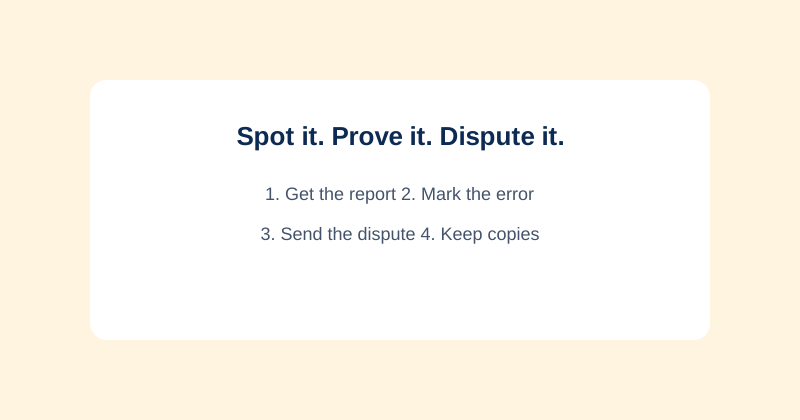
Finding an error on your credit report is unsettling, especially if you are about to rent an apartment or apply for a car loan. The good news is that the process for fixing a real error is straightforward, and you do not need to hire someone to do it for you. You need the report, a clear description of what is wrong, proof if you have it, and a record of what you sent.
Start by slowing down. Many people dispute everything at once, in long angry letters, and that approach rarely helps. A bureau can only investigate what you identify clearly. One error, described precisely, with a document attached, is far stronger than ten vague complaints sent together.
Step 1: Get the right report
Get your reports from AnnualCreditReport.com, the site authorized for free weekly reports from Equifax, Experian, and TransUnion. Note which bureau issued the report with the error. An error on Experian is not automatically fixed by writing to Equifax. You may need to dispute with each bureau that shows the error, separately, and you may also need to contact the company that reported the information, called the furnisher.
Print or save a copy of the report before you dispute anything. Circle or highlight the exact item, and write the date you pulled the report at the top. That copy becomes your before picture, and it helps if you later need to show what changed, or what did not.
Step 2: Identify the error precisely
Common errors include an account that is not yours, a balance that does not match your statement, a payment marked late that you paid on time, an account listed twice, and an account that should have aged off the report but has not. For each error, write one sentence that states the problem in plain terms. For example: this account is not mine, I have never had an account with this lender. Or: this payment was made on March 3, and the enclosed bank statement shows it clearing on March 4.
Step 3: Gather proof, but do not send originals
Useful proof includes bank statements showing a payment, a letter from a lender confirming an account was closed or paid, and identity documents if the issue is a mixed file with someone of a similar name. Send copies, never originals. If you dispute online, upload clear scans. If you dispute by mail, use certified mail with a return receipt, so you have proof of delivery and a date.
Step 4: Write a short dispute letter
A good dispute letter is short. Include your full name, address, date of birth, and the account number for the disputed item, if you have it. State the item, state why it is wrong, state what correction you are asking for, and list the enclosed documents. End by asking the bureau to investigate and send you a written result. Keep the tone calm and factual. You are asking for a correction, not making a legal argument in the first letter.
Step 5: Wait, then follow up in writing
Under federal law, a bureau generally has 30 days to investigate a dispute, with a possible extension in some cases. During that time, the furnisher must review the information and report back to the bureau. If the bureau agrees the item is inaccurate, it must correct or remove it. If it does not agree, it must send you a notice explaining why, and you have the right to add a short statement to your file explaining your side.
What not to do
Do not dispute accurate information and hope it disappears. Do not pay a company that promises to erase accurate negative items, because accurate items generally remain for their normal reporting period. Do not send your Social Security number, bank details, or other sensitive information to a random dispute service you found in an ad. The bureau dispute process itself is free, and you can do it yourself with the steps above.
Advertisement
Affiliate disclosure: This blog may earn a commission if you complete the form on the next page, at no extra cost to you. Spike is not a bureau, lender, or financial adviser.
Continue to Spike My Credit Score →The link above goes to the homepage, where the first form asks for name and email only. US residents only, 18 or older.
Common questions
How long does a dispute take?
Generally about 30 days for a bureau investigation, with possible extensions in some cases. Keep your confirmation number and follow up in writing if you hear nothing.
Should I dispute with the bureau or the lender first?
Start with the bureau that shows the error, and consider disputing with the furnisher as well if the first result does not fix it. Disputing with both creates a clearer record.
Disclaimer: This post is educational only and is not personalized financial advice. For advice about your own credit dispute, talk to a qualified professional.
Related reading: Credit score vs credit report, How to improve your score before you apply, and back to the Spike homepage.