How to Read Your Credit Report Line by Line
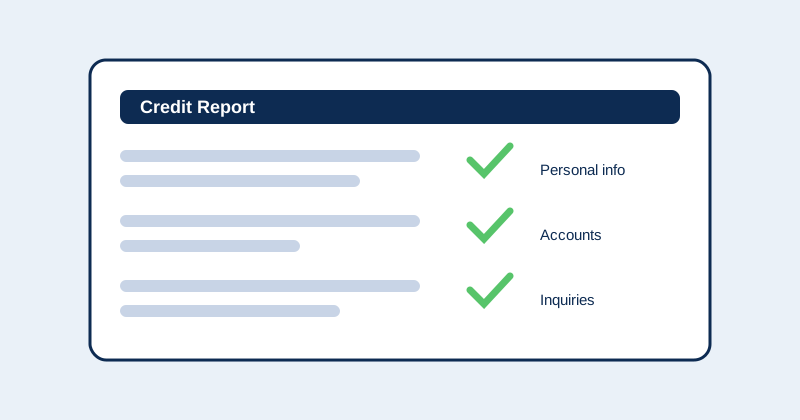
A credit report looks harder than it is. It is long, it is full of dates and codes, and the first page alone can feel like a wall of small print. But a report only has four main sections, and you can read it the same way every time: top to bottom, one section at a time, checking each line against what you already know about your own money.
Start with your own free reports from AnnualCreditReport.com, where you can get reports from Equifax, Experian, and TransUnion. The three reports do not always match each other, because not every lender reports to all three. That is normal, and it is also why it is worth looking at more than one.
1. Personal information
This is the top section, and it is the easiest to check. It lists your name, current and past addresses, date of birth, and sometimes past employers. Spelling mistakes in your name are common and usually harmless, but check the rest carefully. An address you have never lived at, or a name variation you do not recognise, is worth a closer look, because it can be a sign that someone else's information got mixed into your file.
What to check here: your name is spelled right, the addresses are places you actually lived, and there is no employer you never worked for. Small typos are fine to note and move on from. An address you have never heard of is not.
2. Accounts
This is the longest section, and the most important. Every credit card, loan, and line of credit you have had is listed here, usually one entry per account, with the lender's name, the type of account, when it was opened, the credit limit or original loan amount, the current balance, and the payment history.
Read each account and ask three questions. Is this my account? Is the balance and limit about right? And does the payment history show what actually happened? A late payment you did make will show up, and that is fair, even if it hurts to see. But a late payment on a month you paid on time, an account you never opened, or a balance that looks nothing like your statement is an error, and errors are worth disputing. Our guide to disputing report errors step by step walks through how that works.
Pay attention to the account status words, too. "Open" and "closed" are straightforward, but "charged off" or "in collections" means the lender gave up on collecting the debt itself, which is a serious mark. "Paid" or "settled" after such a mark means it was dealt with, but the history of it can stay on the report for years. That is how the system works, and knowing the words helps you read the rest of the file without guessing.
3. Inquiries
Inquiries are a list of who asked to see your report. There are two kinds, and the report usually separates them. Hard inquiries happen when you apply for credit, like a card, a car loan, or a mortgage. Soft inquiries happen when you check your own report, when a lender pre-screens you for an offer, or when an employer runs a background check with your permission.
What to check: every hard inquiry should match an application you actually made, and the date should be about right. A hard inquiry from a lender you never applied to is a red flag and worth disputing. Soft inquiries do not affect your score, so do not worry about the count there. Our post on what a hard inquiry really does explains the difference in more detail.
4. Negative items and public records
The last section collects the serious marks: collections accounts, bankruptcies, and other public records. If you have none of these, this section will be short or empty, which is good news. If there is something here, read it slowly. Check the name of the collector, the original creditor, the amount, and the date. A collection for a bill you already paid, or a debt that is not yours, is an error. A debt that is yours but shows the wrong amount or the wrong date is also worth correcting, because dates decide how long a negative item can stay on your report.
| Section | What it lists | What to check first |
|---|---|---|
| Personal information | Name, addresses, date of birth | Addresses you never lived at |
| Accounts | Cards, loans, balances, payment history | Accounts you never opened, wrong balances, wrong late payments |
| Inquiries | Who asked to see your report | Hard inquiries you never applied for |
| Negative items | Collections, bankruptcies, public records | Wrong amounts, wrong dates, debts that are not yours |
What to do after you read it
Make a short list of anything that does not match your records, with the section, the account name, and what is wrong. Dispute one error at a time with the bureau that shows it, and keep copies of everything you send. While you wait, do not apply for new credit just to test whether the error is gone. And if everything looks right, that is a result too: you now know your file is clean, and you can check again in a few months instead of worrying about it.
One last thing to keep in mind: your report and your score are not the same thing. The report is the record. The score is a number calculated from that record. Reading the report tells you what is actually in the file, which is the part you can check and correct. Our guide to the difference between a credit score and a credit report explains how the two fit together.
Advertisement
Affiliate disclosure: This blog may earn a commission if you complete the form on the next page, at no extra cost to you. Spike is not a bureau, lender, or financial adviser.
Continue to Spike My Credit Score →The link above goes to the homepage, where the first form asks for name and email only. US residents only, 18 or older.
Common questions
How often should I read my full report?
A few times a year is enough for most people, and once before any big application, like a mortgage or an auto loan. You can get free reports from AnnualCreditReport.com, so there is no need to pay for a copy just to check it.
Do the three bureaus show the same thing?
Often, but not always. A lender may report to one bureau and not the others, so an account can appear on one report and be missing from another. That is normal, but it is why checking all three matters when something looks wrong.
How long do negative items stay on a report?
Most negative items stay for up to seven years from the date of the first missed payment, and bankruptcies can stay for up to ten years. The exact timing depends on the type of item, and the dates on the report are what count.
What if I find an error?
Dispute it with the bureau that shows it, with copies of your records as proof. The bureau generally has about 30 days to look into it. Our step-by-step dispute guide covers the process in full.
Disclaimer: This post is educational only and is not personalized financial advice. For advice about your own credit or a specific situation, talk to a qualified professional.
Related reading: How to dispute report errors, Credit score vs credit report, and back to the Spike homepage.