Mortgage Pre-Approval vs Pre-Qualification, Explained Simply
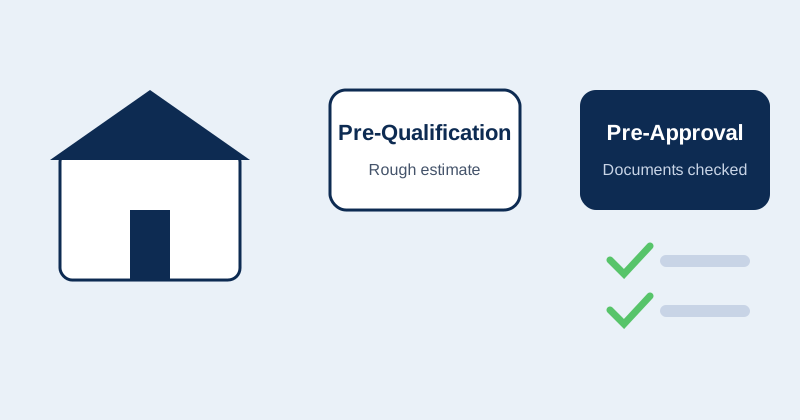
When you start looking at houses, a lender will offer you one of two things, and they sound almost the same: pre-qualification and pre-approval. They are not the same, and mixing them up can cost you time at the exact moment a seller wants a straight answer. The short version is this: pre-qualification is a rough estimate based on numbers you tell the lender, while pre-approval is a closer look based on documents the lender has actually checked.
Neither one is a mortgage. Neither one is a promise that a loan will be made. Both are early steps, and they help in different ways at different stages of a home search.
What pre-qualification actually is
Pre-qualification is usually the first, lightest step. You tell the lender roughly what you earn, what you owe, and how much you have saved, and the lender gives you a rough idea of how much you might be able to borrow. The lender generally does not verify those numbers at this stage, and in many cases does not pull your credit at all, or pulls it only as a soft check.
That makes it fast and low-effort, and useful for exactly one job: getting a sense of your price range before you start touring homes seriously. If you are months away from buying and just want to know whether to look at $250,000 homes or $400,000 homes, pre-qualification is enough. What it is not is something to show a seller. A seller's agent knows the numbers behind it were never checked, so it carries very little weight in a negotiation.
What pre-approval actually is
Pre-approval goes further. You fill out a real application, the lender pulls your credit, and you hand over documents that back up what you said: pay stubs, bank statements, tax returns, and records of debts. The lender checks them, works out how much it is willing to lend and on what terms, and gives you a letter stating that amount.
That letter is stronger than a pre-qualification in two ways. First, a seller can take it more seriously, because the lender has seen real documents. Second, it tells you your own budget with more confidence, because the numbers have been checked rather than guessed. It still is not a final commitment. The lender can still change its mind if your finances change, if the home does not appraise at the price, or if something in the file does not hold up on a final review.
| Pre-qualification | Pre-approval | |
|---|---|---|
| What it is based on | Numbers you report yourself | Documents the lender has checked |
| Credit check | Often none, or a soft check only | Usually a hard inquiry |
| Documents needed | Usually none | Pay stubs, bank statements, tax returns |
| How long it takes | Often the same day | Days, sometimes longer |
| How sellers see it | A rough idea, not much weight | A serious buyer with checked finances |
| What it promises | Nothing binding | Nothing binding, but a firmer indication |
What documents does pre-approval usually involve?
Expect to be asked for proof of income first: recent pay stubs and the last one or two years of tax returns, plus W-2s if you are employed. If you are self-employed, the lender will usually want more: tax returns with schedules, and possibly profit-and-loss statements. Then comes proof of what you own and owe: bank statements showing savings and the money for a down payment, and a list of debts such as car loans, student loans, and credit card balances.
Have these ready before you apply, and keep them in one folder. A missing statement is the most common reason a pre-approval takes an extra week, and in a market where a good house gets several offers in a weekend, a week is a long time. Also, do not move large sums of money between accounts, open a new credit card, or take on a new loan while the lender is reviewing you. New activity in your file can change the numbers the lender is working with, and it can slow the whole process down.
What neither one promises
Here is the part people miss: neither pre-qualification nor pre-approval is a guarantee of a mortgage. A pre-approval letter usually comes with conditions, and it has an expiry date, often 60 to 90 days. If your income changes, if you take on new debt, or if the home's appraisal comes in below the sale price, the lender can revise the amount or step back entirely.
Before either step, it helps to know what a lender will see. Pull your own reports from AnnualCreditReport.com and read them first, so an old error does not surprise you mid-application. Our guides to the difference between a credit score and a credit report and disputing report errors step by step walk through what to check, and what a hard inquiry really does explains the credit check that usually comes with pre-approval.
Which one do you need, and when?
If you are just starting to look and want a rough budget, pre-qualification is fine, and it costs you almost nothing. If you are ready to make offers, get pre-approval instead, and get it before you find the house you love. A seller choosing between two similar offers will usually pick the buyer whose finances have already been checked.
One practical tip: shop pre-approval the same way you would shop any loan. Ask more than one lender, in the same short stretch of days, and compare the same loan amount and term everywhere, so the quotes are actually comparable. And remember the letter is a starting point for a negotiation, not a spending target. Just because a lender says you can borrow a certain amount does not mean you should borrow all of it.
Advertisement
Affiliate disclosure: This blog may earn a commission if you complete the form on the next page, at no extra cost to you. Spike is not a bureau, lender, or financial adviser.
Continue to Spike My Credit Score →The link above goes to the homepage, where the first form asks for name and email only. US residents only, 18 or older.
Common questions
Does pre-approval hurt my credit score?
It usually involves a hard inquiry, and one hard inquiry generally has a small, temporary effect on a score. Several inquiries for the same kind of loan in a short window are often treated as a single shopping event by scoring models, so shopping with two or three lenders in the same stretch of days is the sensible way to do it.
How long does a pre-approval letter last?
Usually 60 to 90 days, depending on the lender. If it expires before you find a house, you will need to update it, which usually means fresh documents and sometimes a fresh credit check.
Can I get pre-approval from more than one lender?
Yes, and comparing offers is a good idea. Use the same loan amount and term with each lender, and compare the total cost, not just the monthly payment.
Does pre-qualification mean I can afford that amount?
Not necessarily. It is an estimate from numbers you reported, and the lender has not verified them. Treat it as a starting point for your own budget, not as a final answer.
Disclaimer: This post is educational only and is not personalized financial advice. For advice about your own credit or a specific mortgage, talk to a qualified professional.
Related reading: Credit score vs credit report, How to dispute report errors, and back to the Spike homepage.